
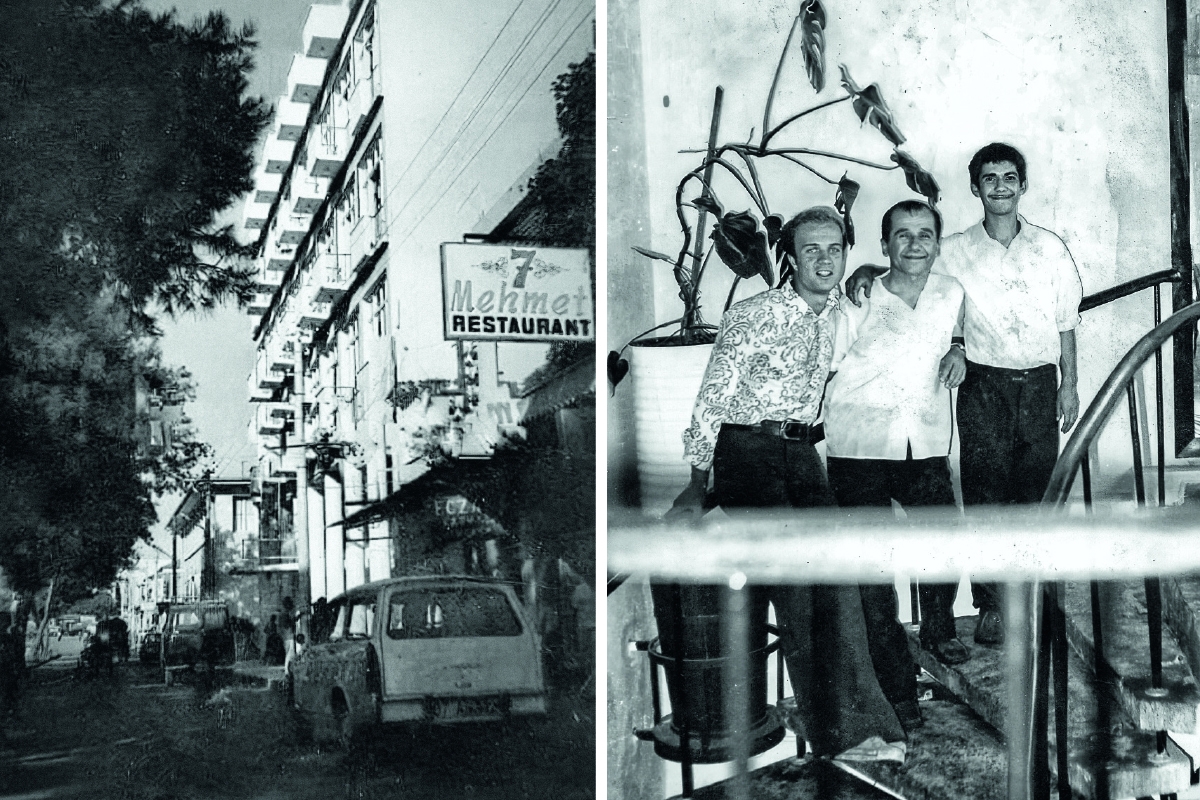
When the municipality began renovation works in the area of the fish market, a demolition order was issued for the corner building that housed the restaurant. My grandfather then moved his establishment to the first floor of the Yayla Palas Hotel, located 200 metres away. He moved it — but as Antalyans are not particularly fond of walking, business did not go well at first due to the new location. There were few guests. At the time, the place was also described as the most luxurious and elegant restaurant in Antalya. For this reason, we placed our first and last advertisement for the Yayla Palas location as a newspaper ad, reading: “For those who care about both their stomach and their wallet, 7 Mehmet is 200 metres ahead!” With the move to Yayla Palas, 7 Mehmet transformed from a simple eatery into a true restaurant. At the top of the elegant wooden staircase leading up from the building entrance stood an imposing aquarium — something no one in Antalya had ever seen before. My father used to tell me that they even travelled to Istanbul to source fish for it, and on the journey back, they kept blowing air into the bags so the fish would not run out of oxygen, breathing life into them all the way to Antalya…
Naturally, with the new venue, the variety of dishes expanded, different beverages were added to the menu, and seating capacity increased. The first signs of the restaurant’s growth appeared here. Once the business settled into its rhythm, they never paused their work. In fact, my grandfather and his team lived through the 1960 coup while at Yayla Palas. Even during curfews, they did not close the restaurant and continued serving food. It was also during the Yayla Palas period that my father, Hakkı Akdağ, began to appear in the kitchen of 7 Mehmet Restaurant at just six or seven years old. The İnönü Primary School my father attended was directly opposite Yayla Palas. As they later learned, my father had a condition affecting his eyes; when he focused on something, his eyes would water, making him appear as if he were crying. At school, while looking at the teacher, the blackboard or his notebook, his eyes would water as well. His teacher — also a friend of my grandfather — would take him by the ear, walk him across the street, leave him in the restaurant’s dishwashing area and say, “You’ll never amount to anything — at least work here!” Later on, my father would joke about this, saying, “The man was farsighted after all — look, we became restaurateurs.” The years in which my father assisted my grandfather as his apprentice passed quickly. He would even tell us this rather remarkable story: when he came home on leave from the army, my grandfather would send the head chef on leave so that my father could help him in the kitchen. My father would complain, “I’ve come home on leave from the army — why are you making me work, father?” Although he was deeply upset at the time, when he later told us this story, he would become emotional, emphasising how meaningful and valuable his father’s gesture truly was.